
0402 Warm White Micro LEDs: The Complete Buyer’s Guide for Model Builders
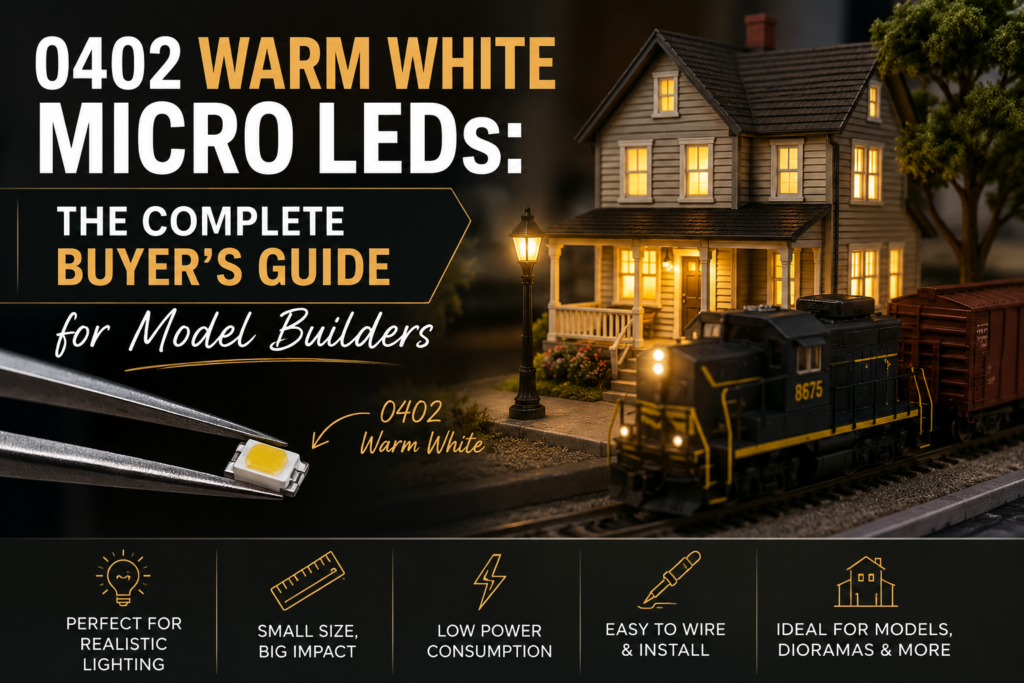
erything hobbyists need to know about sourcing, wiring, and installing 0402 warm white micro LEDs and why more modelers are switching to pre-wired versions.
Why 0402 Warm White LEDs Matter to Model Builders
Search almost any model railroading, dollhouse, or diorama forum and you’ll find the same conversation repeating itself: someone needs a tiny, realistic light source, and the tools sold in most hobby shops just aren’t small enough. That’s where the 0402 micro LED comes in a surface-mount component roughly the size of a grain of sand that, in warm white, reproduces the soft glow of an old incandescent bulb with startling accuracy.
A well-known 2021 thread on the Trains.com Model Railroader forum, “I need a bunch of 0402 Warm White LEDs Finally, SUCCESS!,” captures the problem perfectly. The original poster needed discrete warm white units to build a string of lights for an icing platform and tank car loading rack, but couldn’t find stock through standard electronics suppliers like Digi-Key. What followed was seventeen replies from experienced modelers trading sourcing tips, soldering techniques, and again and again the same conclusion: buying LEDs pre-wired saves an enormous amount of frustration.
What Exactly Is a 0402 LED?
The “0402” designation refers to the physical footprint of the surface-mount LED package, measured in hundredths of an inch (4 x 2, or roughly 1.0 x 0.5mm). In practice, that makes the LED itself smaller than a printed letter on this page around 1 x 0.5 x 0.4mm, comparable to the size listed on commercial pre-wired 0402 warm white packs sold to the scale modeling market.
These LEDs typically run on a nominal 3V forward voltage, which makes them well suited to coin-cell batteries, low-voltage DC bus wiring, or microcontroller-driven projects using Arduino or Raspberry Pi. Because the diode itself has almost no surface area, even a small amount of current produces a bright point of light which is exactly what’s needed to simulate an interior lamp, a headlight, or a cockpit gauge at 1:87, 1:48, 1:24, or dollhouse scale.
Why Warm White Specifically
Cool white and blue-white LEDs are common and cheap, but they don’t look right in a scene meant to evoke a particular era. Warm white LEDs are tuned to a color temperature that mimics incandescent filament bulbs the yellow-orange glow found in vintage train stations, 1950s house windows, oil lamps, and classic car dashboards. For modelers recreating any pre-LED-era setting, warm white isn’t a stylistic preference; it’s the only version that reads as authentic under a magnifying loupe or in a photograph.
This is precisely the color of light hobbyists on the Trains.com thread were chasing for their icing platform lamps, and it’s the same rationale that shows up across dollhouse lighting, Gunpla and mecha model kit lighting, diecast car interiors, cosplay prop electronics, and diorama builders working in any scale.
The Soldering Problem And Why So Many Modelers Give Up On DIY
Buying bare 0402 LEDs and wiring them yourself is possible, but the forum thread is a useful reality check on how difficult it actually is in practice:
- Wire gauge matters more than people expect. Several posters recommended #36 stranded Litz wire (around 0.28mm insulated diameter) because anything thicker overwhelms the tiny solder pads.
- Shaky hands are the enemy. One longtime modeler described routinely damaging at least one LED per session, even after decades of soldering experience.
- Custom jigs become mandatory. Builders resorted to modified paint edgers, bent surgical hemostat clamps, and 3D-printed “duck-bill” holders just to keep an LED still long enough to solder both leads without desoldering the first one in the process.
- Sourcing bare components is inconsistent. The original poster struck out with Digi-Key entirely and had to rely on eBay listings and specialty suppliers like East Coast Circuits and Ngineering.
By the end of the thread, at least three separate posters independently, without prompting stated some version of “I’m lazy, so I just buy the pre-wired ones now.” One called it “a lot less pain in my old caboose.” Another said soldering the wires is “more trouble than” anything else in the build. That’s not a fringe opinion; it’s the dominant conclusion among experienced modelers who’ve tried both approaches.
Pre-Wired 0402 LEDs: What You’re Actually Paying For
A pre-wired 0402 micro LED is exactly what it sounds like: the manufacturer solders ultra-fine enamel-coated leads onto the LED at the factory, under magnification and with production-grade equipment, before it ever reaches you. Commercial listings for these components emphasize a few consistent selling points, and they match what the forum community was asking for:
- No soldering required at the LED itself you’re only making connections at the far end of the lead wire, which is far more forgiving.
- Consistent, reliable solder joints, since factory assembly avoids the inconsistency of hand-soldering under a loupe.
- Ultra-thin, flexible leads that can be threaded through window frames, roof vents, or figure bodies without visible bulk.
- Time savings that scale with project size stringing ten or twenty pre-wired LEDs together is a fraction of the time it takes to solder that many by hand.
The tradeoff is cost per unit: pre-wired LEDs carry a premium over buying bare diodes in bulk. For a one-off project with a single light, that premium may not matter. For anyone lighting an entire structure, a full string of icing-platform-style lamps, or a fleet of models, most hobbyists on the forum ultimately decided the time saved was worth more than the price difference.
Where Modelers Actually Use 0402 Warm White LEDs
- Model railroad structures station interiors, freight house lighting, icing platforms, loading racks, and passenger coach windows (the exact use case that started the Trains.com thread).
- Dollhouses and scale furniture table lamps, chandeliers, and room lighting where a warm, incandescent-style glow reads as realistic.
- Dioramas and miniature scenes ambient interior lighting for buildings, vehicles, and street lamps.
- Model vehicle interiors dashboard lights, cabin lighting, and headlights in scale cars, trucks, and aircraft.
- Gunpla, mecha kits, and cosplay props internal lighting effects for eyes, chest units, and other small enclosed spaces where a bulky LED simply won’t fit.
- General hobby electronics low-voltage, battery-powered, or microcontroller-driven circuits where component size is the limiting factor.
Installation Basics: Wiring 0402 LEDs Correctly
Regardless of whether you solder your own or buy pre-wired units, a few wiring fundamentals came up repeatedly among experienced builders on the forum:
- Wire in parallel, not series, when lighting multiple points from a shared power source this keeps each LED at consistent brightness even if others fail or vary slightly.
- Use a current-limiting resistor. Several builders cited values around 1,000 ohms to bring the LED’s brightness down to a believable incandescent level rather than an unrealistically intense point of light.
- Mind polarity. LEDs are directional; reversing the leads simply won’t light the circuit, so test each unit against your power source before final installation.
- Protect the leads. A small dab of clear cement, canopy glue, or epoxy at the base of the wires adds mechanical strength and prevents the fragile connection point from working loose over time.
- Consider a lamp shade or diffuser. Small metal or 3D-printed shades or simply dipping the LED in clear epoxy soften the point-source glow into something that reads more like a real light fixture at scale distance.
What to Look for When Buying 0402 Warm White LEDs
- Confirmed warm white color temperature, not “natural white” or “warm” listings that are actually closer to neutral or cool tones.
- Clearly stated forward voltage (commonly 3V) so you know how to power the circuit safely.
- Pre-wired construction with fine, flexible leads if you’re not set up for microscope-level soldering.
- A supplier that specializes in hobby and model lighting, rather than a generic electronics reseller — specialty suppliers are far more likely to have consistent stock, correct color binning, and leads sized appropriately for scale work.
The Bottom Line
The Trains.com thread is, in miniature, the whole story of 0402 warm white LEDs in the hobby world: the components themselves are inexpensive and widely available, but hand-soldering them reliably takes specialized tools, patience, and by more than one veteran modeler’s own admission a very steady hand. That’s exactly why pre-wired 0402 warm white micro LEDs have become the default choice for hobbyists who want realistic, era-appropriate lighting without spending an evening fighting with a soldering iron and a magnifying loupe.
A lot of hobbyists end up checking places like Evan Designs
when they need pre-wired micro LEDs that are ready to install straight out of the pack. Evan Designs stocks pre-wired micro LEDs and battery packs built specifically for model railroading, dollhouses, dioramas, Gunpla and mecha kits, diecast customization, and cosplay props the same use cases that kept coming up throughout the forum discussion so builders can skip the sourcing and soldering headaches entirely and get straight to lighting the model.

Hi, I am Cynthia Petrillo was brought into the world in California, Studied at University of Southern California. Fiery to bestow my knowledge to charmed people. I have extensive stretches of inclusion with the field of Business, Health and Information Technology. Beside that, I love to contribute energy with my family.